Why Your Keyword Planner Forecast Is Wrong
Google's bid range midpoint is not your CPC. Here is what the forecast actually reports, why agencies quote from it anyway, and how to build a number you can hold someone to.
日本語で読む → Victor Firestone
Key takeaways
- 01The bid range in Keyword Planner is a bid range, not a cost-per-click range. Quoting its midpoint as your CPC overstates volume and understates cost.
- 02Use the forecast tool with a real daily budget rather than reading the bid columns, and the numbers get much closer to reality.
- 03Any projection built before conversion tracking works is a guess wearing a spreadsheet.
Almost every underperforming paid search pilot I have looked at traces back to the same moment: someone opened Keyword Planner, saw a bid range of $4 to $12, wrote “$8 CPC” into a spreadsheet, and built a forecast on top of it.
That number was wrong before anything else happened.
What the bid range actually reports
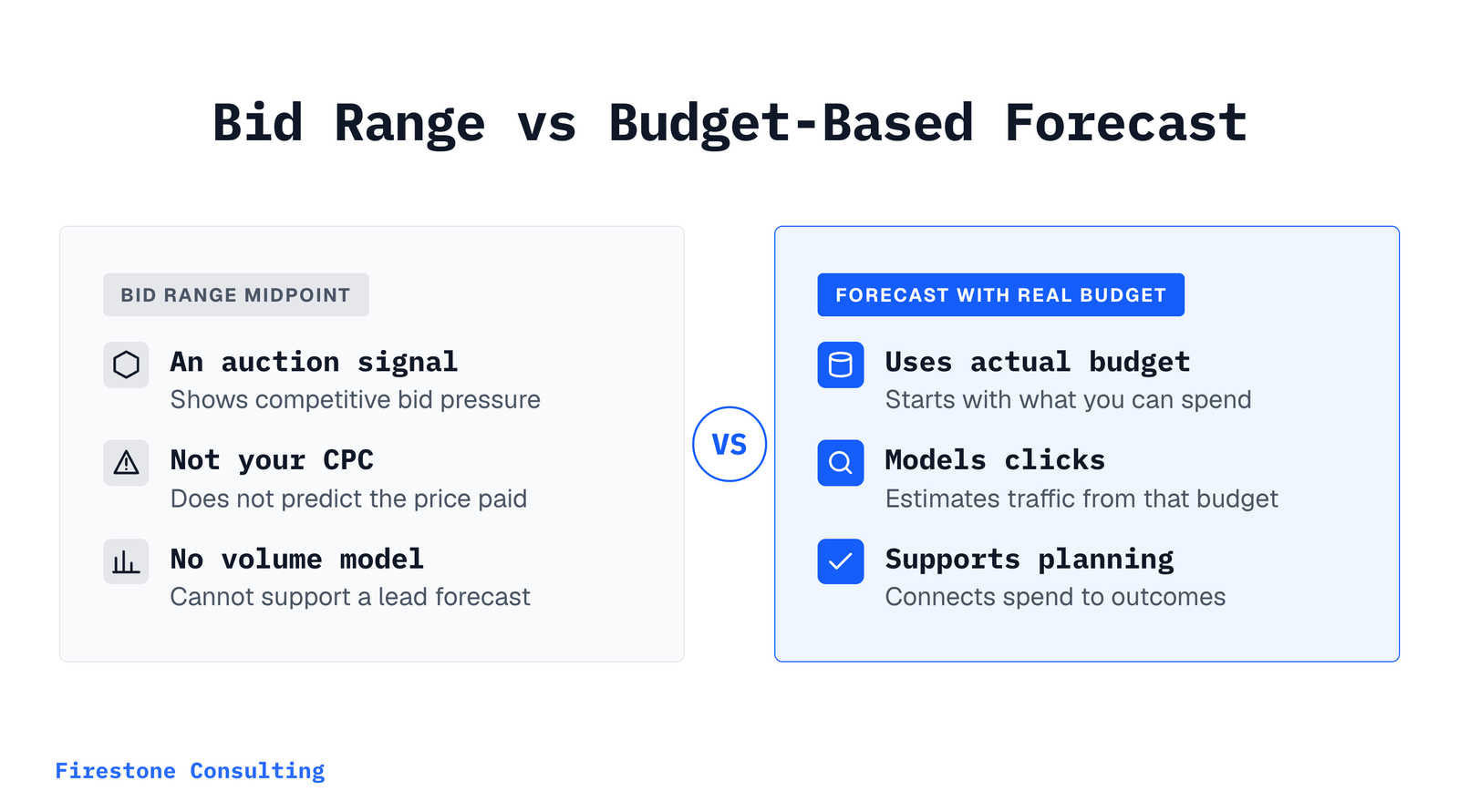
The two bid columns are top of page bid (low range) and top of page bid (high range). They describe what advertisers have been bidding to appear at the top of the page — not what they paid per click.
Those differ for a few reasons at once:
- Auction pricing means you typically pay less than your maximum bid
- Quality Score moves your effective cost independently of the bid
- The range is aggregated across advertisers with very different landing pages and histories
- Seasonality is flattened into a single figure
So the midpoint is not a central estimate of anything meaningful. It is the middle of two numbers that were never a distribution of costs to begin with.
Why the error compounds
The CPC does not sit in a forecast on its own. It multiplies:
clicks    = budget / CPC
leads     = clicks × conversion rate
customers = leads × close rate
revenue   = customers × deal value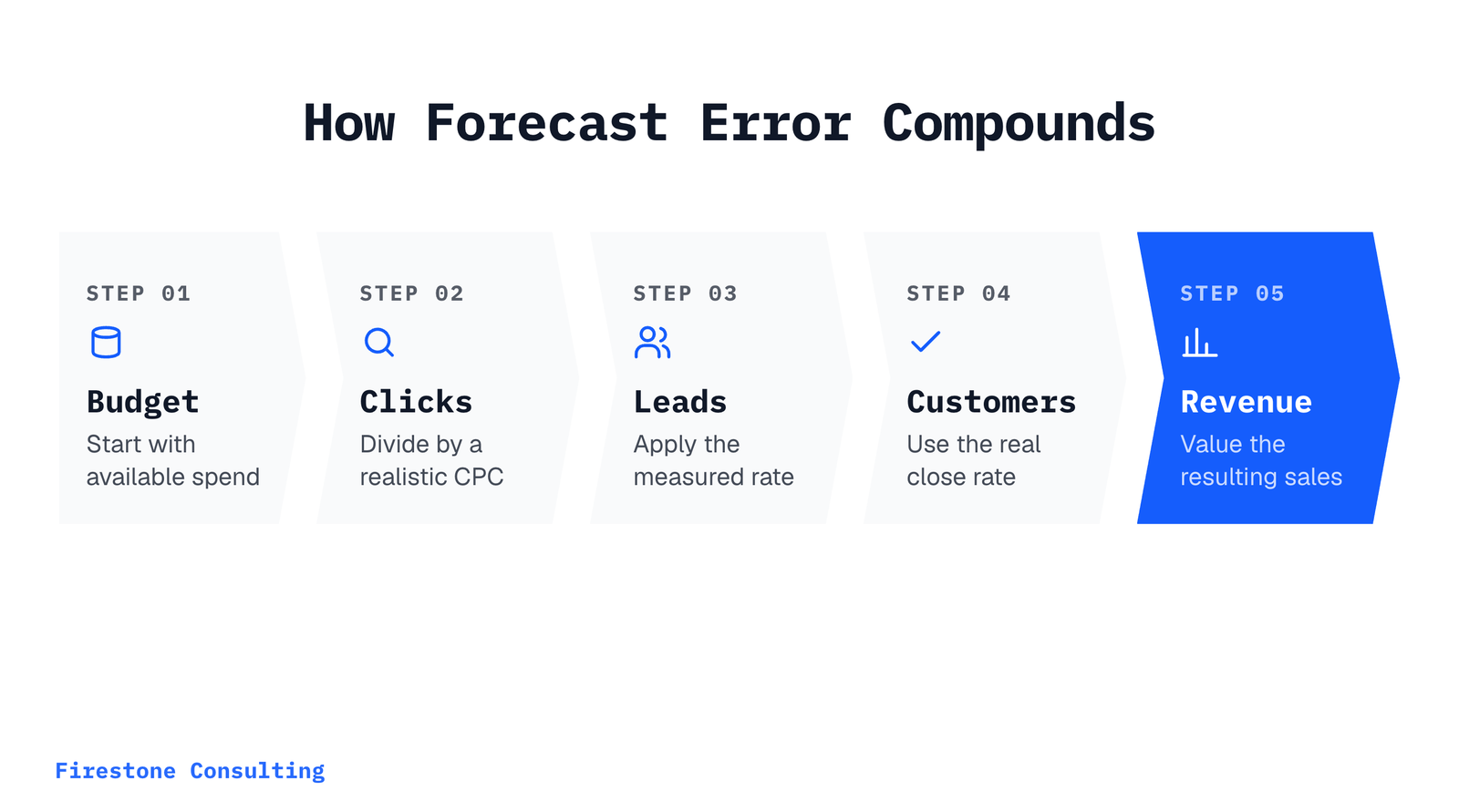
Understate CPC and you overstate clicks. Overstated clicks flow into leads, then customers, then revenue. A 40% error at the top becomes a 40% error at the bottom, and it is the bottom number people remember when the pilot is reviewed.
Every optimistic assumption in a funnel model multiplies. This is why conservative inputs matter more than clever ones.
A better process
Use the forecast tool, not the bid columns. Enter your keyword list, set the actual daily budget you plan to spend, and read the CPC it returns. That figure accounts for how the budget constrains delivery, which the bid range does not.
Sanity-check against the high end. If the forecast disagrees with the bid range midpoint, trust the forecast. If you have neither, use the high end of the bid range and treat the result as a ceiling rather than a plan.
Model a floor, not a target. Build the case at the pessimistic end. A pilot that clears a conservative bar is a pilot you can scale; one that only works at the optimistic end will be judged a failure at month two.
| Input | Naive approach | Better approach |
|---|---|---|
| CPC | Bid range midpoint | Forecast tool at real budget |
| Conversion rate | Industry benchmark | Prospect’s own historical rate |
| Close rate | Assumed | Asked for during discovery |
| Deal value | Headline price | Verified average, net of discounts |
The prerequisite nobody mentions
None of this matters if conversion tracking is broken, and it usually is. If conversions are not firing, or are firing on the wrong action, or are double-counting because two tags are installed, then every number downstream of the click is fiction.
Check the measurement layer before you build the model. It is unglamorous, it takes an afternoon, and it is the difference between a forecast and a guess with formatting.
Frequently Asked Questions
Is Keyword Planner useless then?
No. It is good for discovering terms and comparing relative demand between them. It is unreliable as a source of absolute cost projections, which is the job people usually give it.
What CPC should I use for a first model?
Run the forecast tool at the daily budget you actually intend to spend and take the CPC it returns. If you have no better source, use the high end of the bid range rather than the midpoint.
Turn campaign uncertainty into a clear next step.
Book a call and we will identify the highest-leverage improvement.
Book a CallVictor Firestone
Founder of Firestone Consulting. Specializing in B2B paid ads management and lead generation using Google Ads and Meta Ads. Supporting businesses from startups to established enterprises with strategic marketing solutions.
Ready to build a reliable acquisition system?
We connect paid media, measurement, and conversion paths into one system.
Book a Call